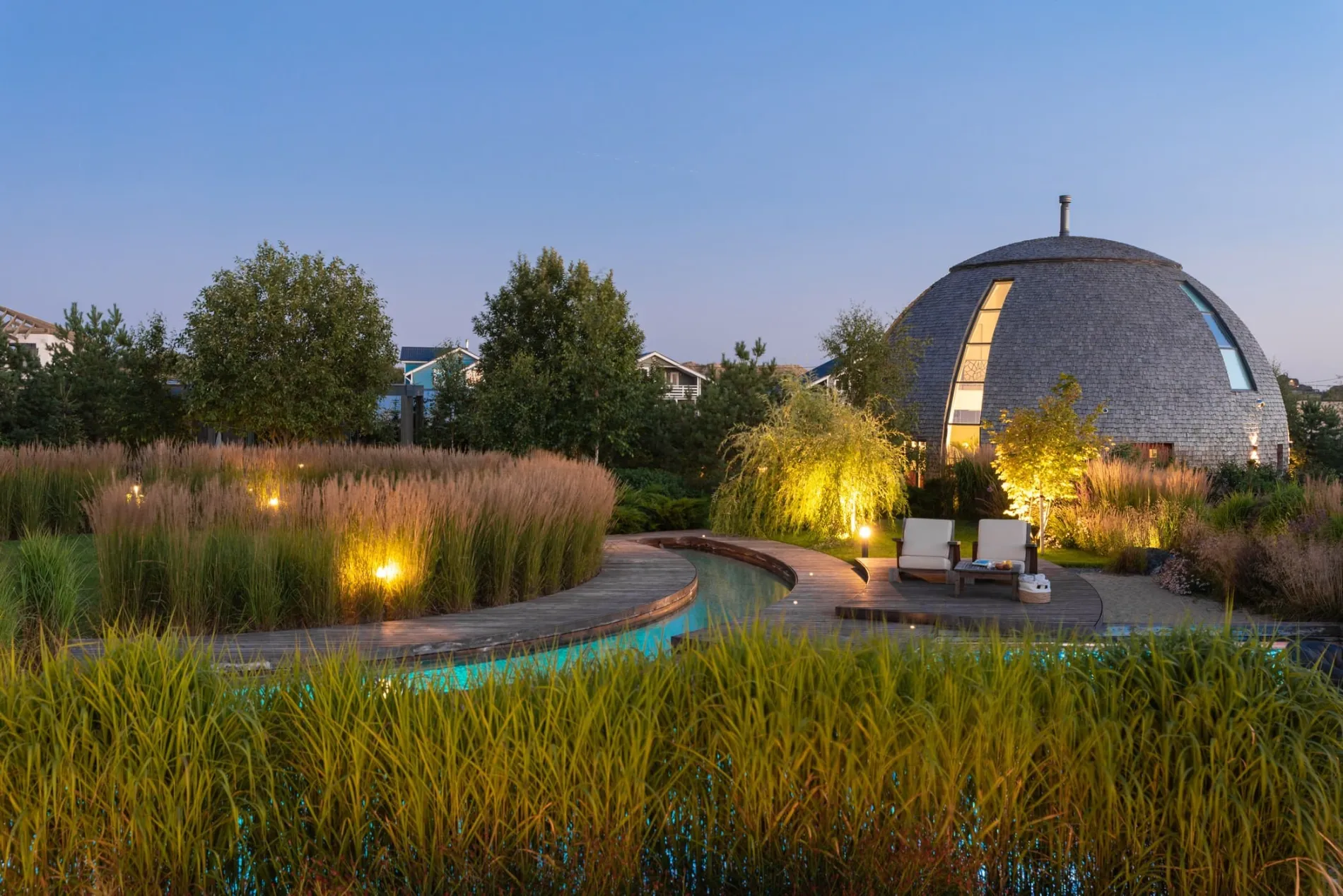
Landscape Design and Greening: a Natural Garden
BIOCENOSIS IN THE GARDEN — A RESILIENT LIVING SYSTEM INSTEAD OF A COLLECTION OF PLANTS
-
A biocenosis is a community of plants, pollinators, birds and beneficial soil microflora linked together into a single system. In nature such communities settle into equilibrium on their own: a meadow, a forest edge or a pine wood goes for decades without watering, weeding or fertilizing. They simply live.Conventional decorative planting ignores this principle. Plants are chosen for the picture they make, not for whether they will get along with one another or whether the light, soil and moisture of the particular site suit them. That is why such a garden demands constant intervention — it holds out against nature rather than living with it.A resilient biocenosis works the other way around. When the species are chosen correctly, they begin to support one another and regulate the environment themselves:
- some plants shade and acidify the soil — and alongside them thrive the ones that need exactly that soil;
- others structure the ground with their deep roots;
- still others keep weeds in check by leaving them no open ground;
- leaf litter and spent grasses return organic matter to the soil — the garden feeds itself.
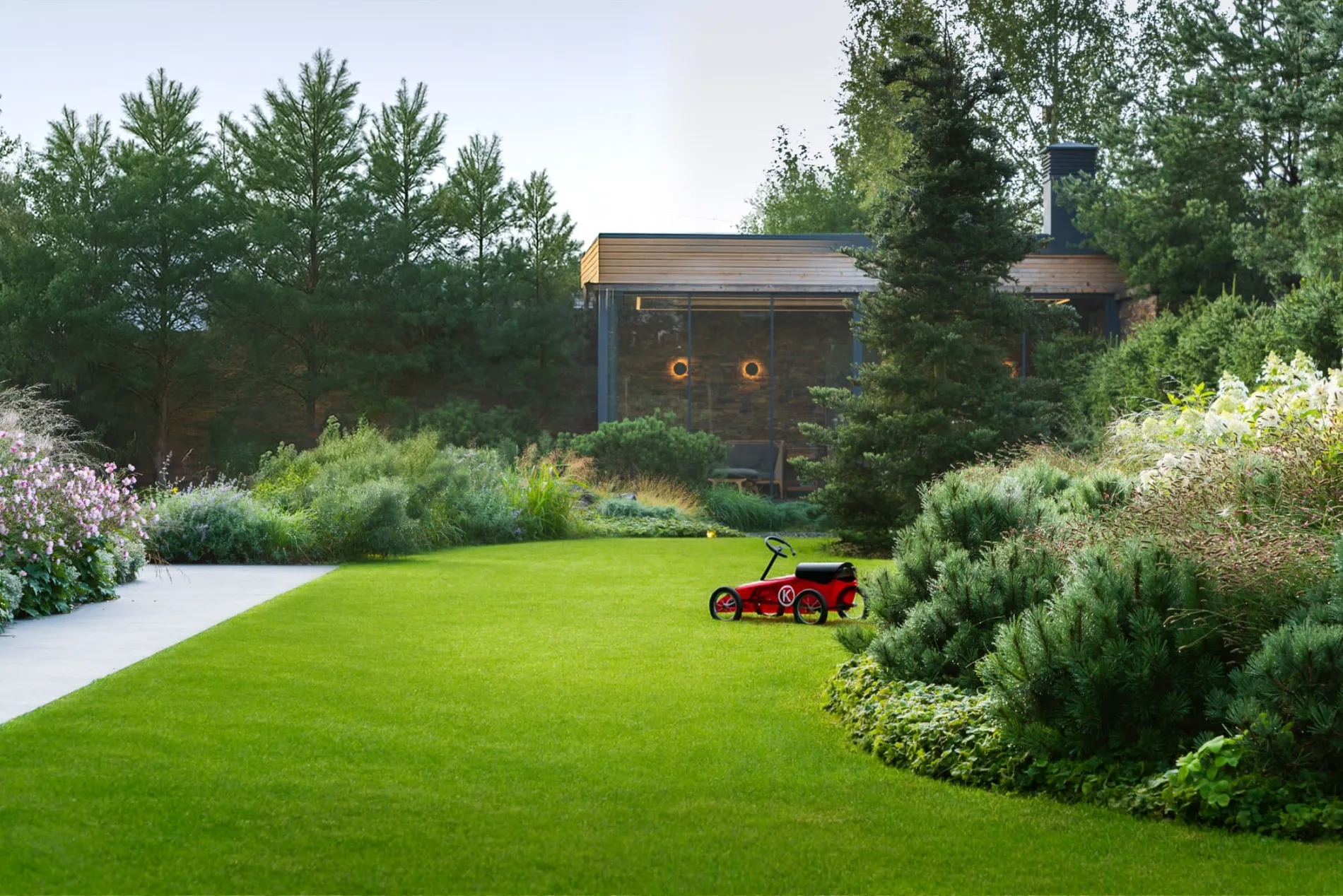
Such a community needs almost no maintenance, because it works like a natural system. Creating it is difficult — you have to understand precisely how plants coexist with one another — which is why most take the familiar route and lay lawns instead. Yet a lawn is arguably the most expensive and maintenance-hungry element of a landscape, even though from the outside it looks like the simplest solution.

Low maintenance is not about “planting whatever is cheapest” — it is a well-composed plant community, a resilient biocenosis in which the plants support one another and regulate their own environment.
-
A healthy plant community is also resistant to pests: the species keep one another in balance, so outbreaks of disease and insect invasions happen less often, and the need for chemical treatment is kept to a minimum. The garden stays alive — and well-kept at the same time.
Black box gardening — a natural, ever-changing meadow created by self-seeding
-
Black box gardening is the design of a natural meadow that lives and changes on its own. Plants are chosen so that they flower in succession: in spring the meadow looks one way, in midsummer quite another, and by autumn a third. The picture redraws itself every few weeks following a pre-written scenario, and within a single season the same plot manages to show several different moods.This is what programming living nature in time means. The gardener sets the starting conditions and the plant palette, and from then on the community develops by itself — hence the name “black box”: the exact result cannot be mapped out to the centimeter, but it can be choreographed in time.
Black box gardening — what it is and where the method comes from
The approach grew out of the naturalistic current in world landscape design — the very one behind the work of Piet Oudolf and the New Perennial movement. Its idea is simple: a garden should look and behave like living nature, not like a clipped exhibit. Dynamics, self-seeding and the change of textures through the seasons are not a flaw here but the intent.How a self-seeding garden works — plant dynamics over time
- Selection by flowering time. Species are arranged into a continuous relay — as some finish flowering, others come into their own.
- A focus on perennials and ornamental grasses. They give the garden structure, movement and sound, and in autumn and winter they hold the picture with dry seed heads and the graphic lines of stems under the snow.
- Controlled self-seeding. Some plants are deliberately allowed to spread across the site and find the spots where they feel most at home — every year the garden slightly rewrites itself while staying within the design.
How a natural garden differs from an abandoned plot
Neglected land grows over with random weeds. A natural meadow is designed: the palette of species is chosen to hold its balance and change beautifully without slipping into chaos. The difference is like that between noise and music composed in advance.
A low-maintenance natural garden that needs minimal care
-
A low-maintenance garden is not a lawn mowed every week but a resilient community that sustains itself. Plants for such a garden are selected for hardiness and compatibility: at DEREVO PARK’s trial grounds we watch how different species get along with one another for years before they make it into a project.A simple example: needles fall from a spruce and acidify the soil — and right beside it a rhododendron, which needs exactly that soil, thrives. The result is a natural ecosystem that only needs to be studied and transferred to the client’s property. The same grounds serve for holding plant material: it stays under observation, is treated and grown on when necessary, and only then travels to the garden. Behind every planting decision stand years of observation, not a picture from a catalog.
Plants for a natural garden — ornamental grasses and perennials in the project
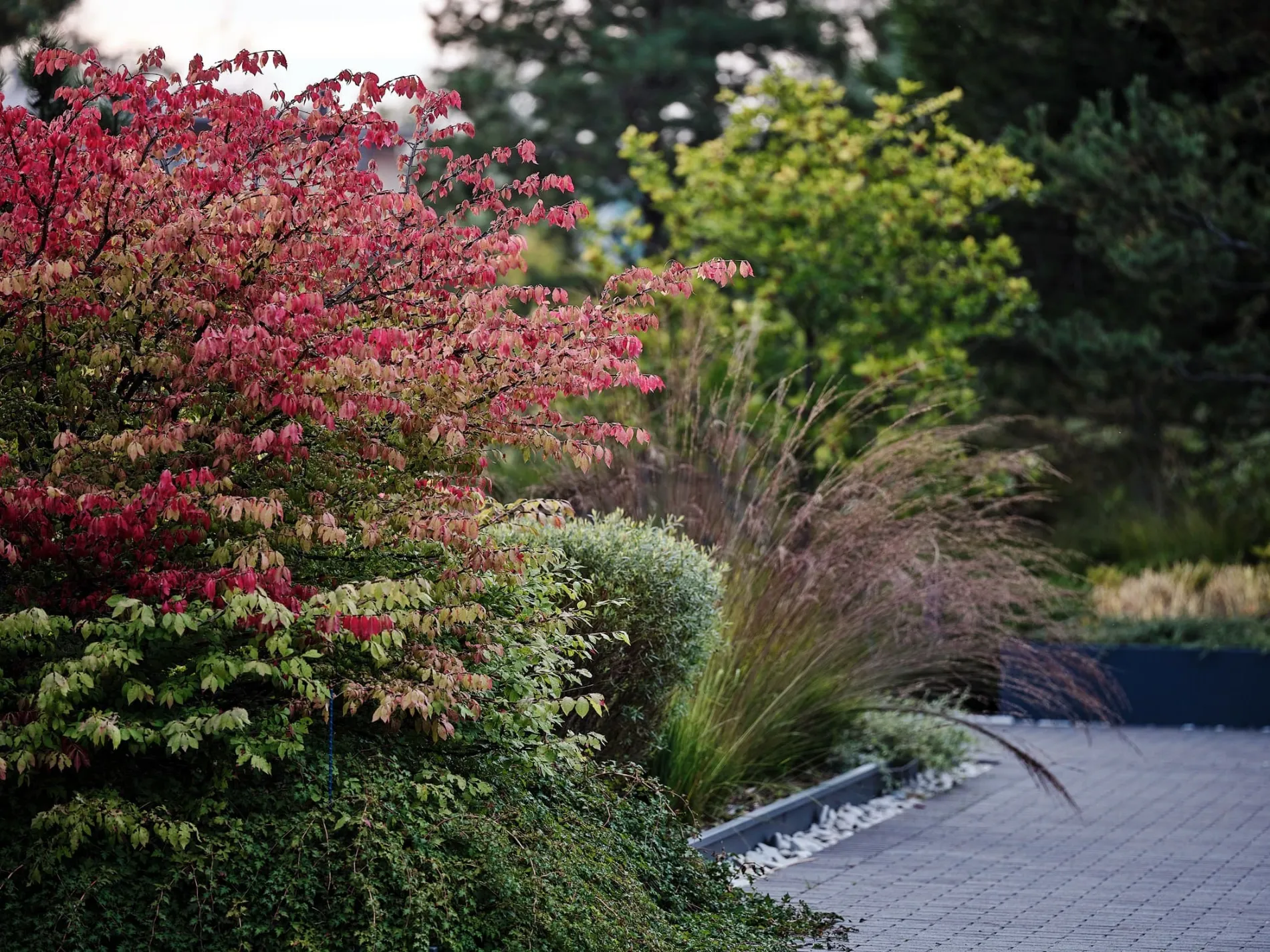
The backbone of a natural garden is ornamental grasses and perennials that hold their shape from spring until the snow. Among the grasses — molinia, reed grass, sporobolus, feather grass and tufted hair grass: they give the garden movement, volume and the graphic lines of dry seed heads in winter. Among the perennials — echinacea, woodland sage, catmint, yarrow, burnet, sedum and sea holly: they bloom in waves, succeeding one another, and create that signature New Wave palette in the spirit of Piet Oudolf.A garden for pollinators — plants for bees and butterflies
A natural garden lives on more than plants. Nectar plants — catmint, oregano, echinacea, sedum, lavender — attract bees, bumblebees and butterflies. This is both natural pest control and a living, moving garden instead of a static picture.
Turnkey site greening — the stages of creating a garden
-
Turnkey site greening is a sequence of stages, at each of which the garden is laid down to live for decades:
- Reading the site. Soil, water, light, terrain, microclimate, frost pockets and wind corridors. Without this, any planting is a lottery.
- Plant communities instead of flower beds. Species are assembled by the logic of natural biotopes — with layering and closure, where perennials support one another and leave no room for weeds.
- The garden across time. We calculate what will dominate in year three and what in year ten, when the crowns will close and what will retreat into shade. Visualizations show the mature garden, not the day it was planted.
- The winter framework. For eight months the garden stands without foliage — which is why the graphic lines of bare branches, colored bark, conifer accents, ornamental grasses and seed heads under the snow are built in at the design stage.
- Aftercare. Through its first seasons the garden is managed by a seasonal calendar until the community reaches self-regulation.
Topographic survey, drainage and automatic irrigation — the engineering of the garden
All greening begins underground. A topographic survey and the site’s hydrogeology show where water goes and where it stagnates; drainage carries excess moisture away from roots and retaining walls, and part of the water returns as irrigation. Automatic irrigation lifts the daily routine from the owner, and its lines are laid before planting — not by cutting open a finished garden.The garden design and the landscape architect’s design supervision
Behind the result stands documentation: a topographic survey, a master plan, a dendrological plan and working drawings. Plants are selected and planted according to the design, and construction runs under design supervision — the same architect makes sure the garden grows up exactly as intended. Mature specimens and expensive trees are covered by a survival-based replacement policy.
Turnkey landscaping and greening for a private home
-
Beautiful plants do not survive on a poorly prepared site. That is why at DEREVO PARK greening is the final layer of comprehensive site improvement, not a stand-alone service. Site improvement is not pavers and curbs — it is the engineering foundation that holds up a living garden: the site is first put in order in engineering terms, and only then are the plants brought in.Comprehensive site improvement includes:
- Drainage and groundwater management — so the roots do not get waterlogged, excess water drains away, and part of it comes back for irrigation.
- Landforming — terraces, viewpoints and stable slopes; cut equals fill, so surplus soil is not hauled away unnecessarily.
- Water as an engineered system — streams, cascades and reflective pools with the hydraulics and winter regime calculated, not a ready-made basin from a catalog.
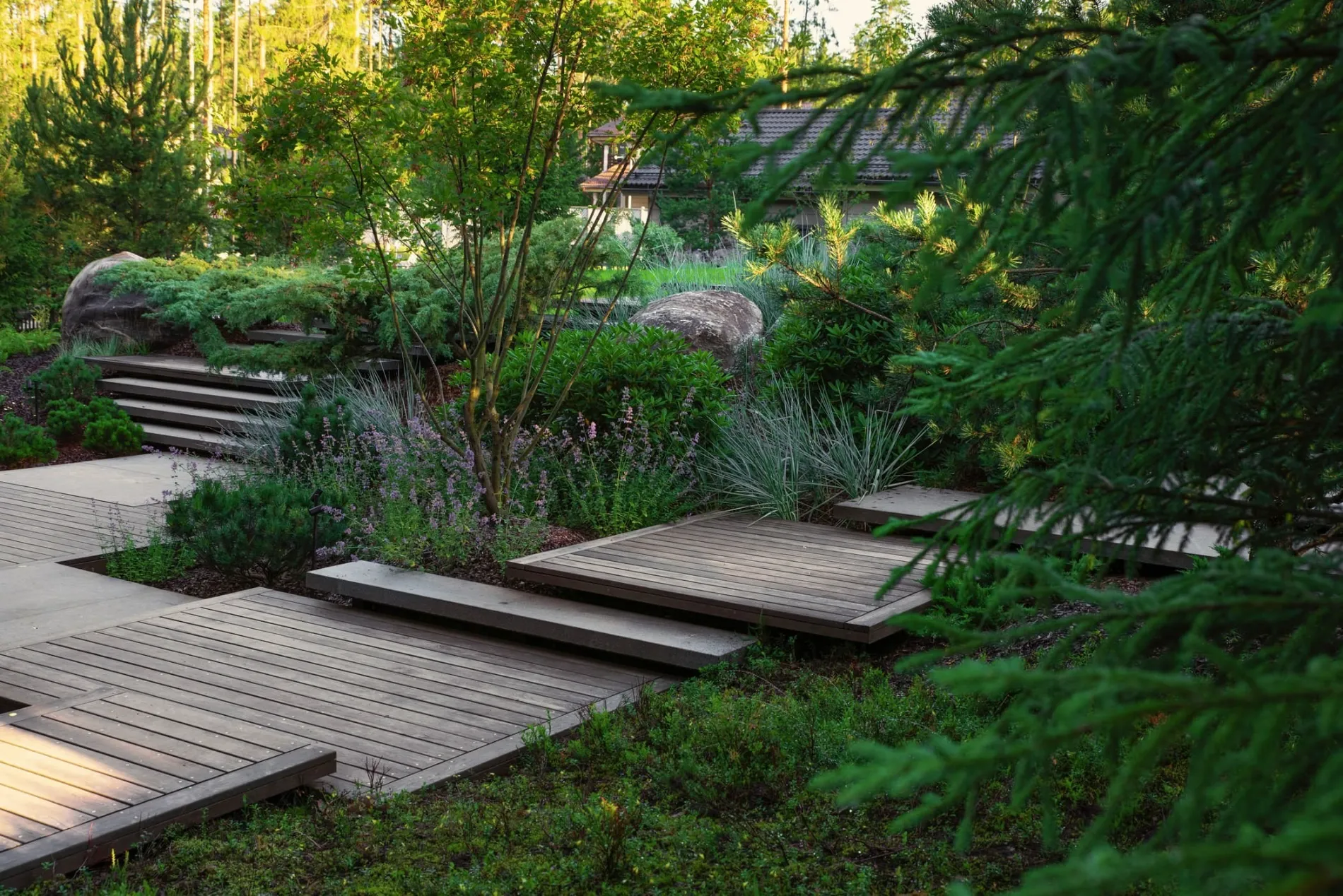
- Paths, paved areas and surfaces — they link the site’s scenarios: morning, day, evening.
- Light as scenography — the shadow graphics of tree crowns, warm light matched to bark and conifer needles, a separate picture for the garden at night and in winter, not just path lighting.
- Small architectural forms — from classic pieces to neural-network-based art objects that change their lighting, sound and shape in response to movement and weather.
- Automatic irrigation — so the garden lives without daily manual labor.
All of this is designed and built by one team — the company’s in-house engineering, architectural, construction and cost-estimating departments. So site improvement and greening never clash on the construction site but come together into a single environment: the drainage is sized for the specific plants, the lighting for their crowns, and the budget and schedule are fixed in advance.
Garden landscape design for the busy owner — the value of the natural approach
-
Naturalistic landscape design pays off above all for those who have no time for daily upkeep of their property. What it gives the owner:
- Maintenance drops severalfold — less watering, weeding, mowing and feeding.
- The garden grows more beautiful with every year instead of falling apart after planting.
- It stays ornamental all year round — from spring bloom to the graphic lines of grasses under the snow.
- The site comes alive — butterflies, bumblebees, birds; the garden sounds and moves.
- The solution is resilient — the plantings withstand both a dry summer and an unpredictable winter.
A living garden also works for your well-being. The effect of a green environment on people is backed by research:- −37% amygdala activity (the brain region responsible for stress) in residents of green neighborhoods — Lederbogen F. et al., Nature, 2011;
- +4 points on the General Health Questionnaire after moving to a green neighborhood — Alcock I. et al., Environmental Science & Technology, 2014;
- a 5-minute walk is the critical threshold of access to greenery beyond which the effect kicks in — Harvard T.H. Chan School of Public Health, 2024.
Well-designed greening is a habitat that lowers stress and restores a sense of calm. That is why landscape today is valued not as decoration but as part of quality of life.
Greening in Saint Petersburg, Moscow and the regions of Russia
-
DEREVO PARK works across Russia: the core teams are based in Saint Petersburg and Moscow, with projects ranging from the two capitals to country residences in other regions. For every site, plants are selected with the local climate, soil composition and winter hardiness in mind, so the garden performs just as reliably in the Northwest as it does in central Russia.Turnkey site greening, a bespoke dendrological plan, a resilient biocenosis and a natural meadow in the black box gardening technique are available in Saint Petersburg and Moscow as well as beyond them — with dendrologists traveling to the site and full garden support.
Greening a forested site
Preserve the trees and pines
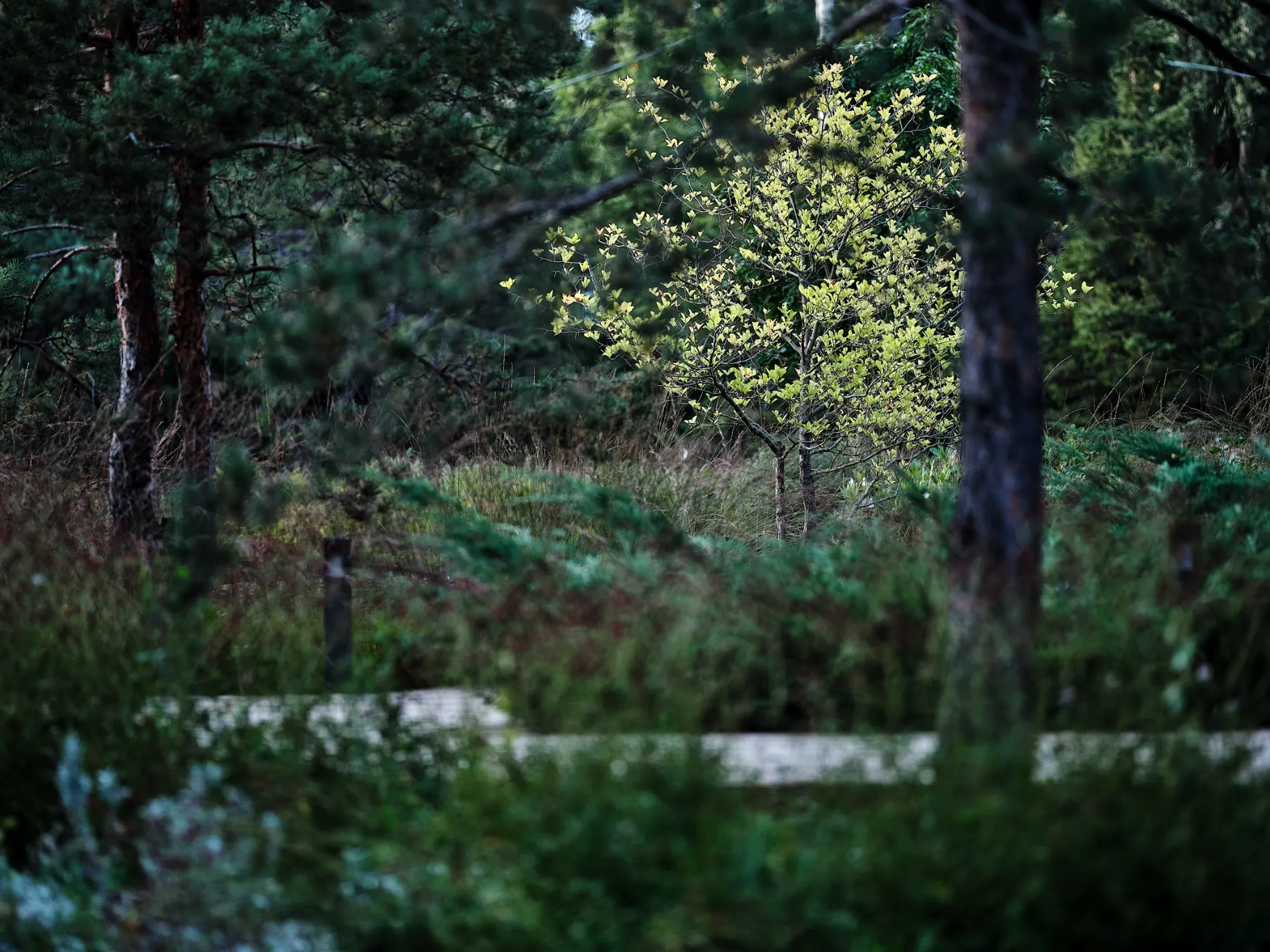
A forested plot is a value — and a task — of its own. A mature pine or spruce stand cannot be bought for any money or grown in a single season, so during greening such trees are preserved, not felled.
Before construction, a dendrological plan is drawn up assessing the viability of every mature tree, the root protection zone is calculated, and work rules are set within the footprint of the preserved pines. New plantings are chosen for acidic forest soil and shade — rhododendrons, ferns, hostas, heathers — so that the young garden blends organically into the established forest.
Preserve the trees and pines
Why DEREVO PARK — a signature approach to greening
-
DEREVO PARK has been at work since 2009 and ranks among the country’s leading landscape companies — “Best Landscape Bureau” according to Urban Awards 2026, more than 250 premium projects and over 600 ha of landscaping, with work in Saint Petersburg, Moscow and other regions of Russia.Behind the result stands a full cycle within a single team: engineering, architectural, construction and cost-estimating departments. The company is fluent in different stylistic languages — from Oudolf-style naturalism to the Japanese way of working with stone and pause — while planting material is hand-picked at nurseries in Russia and Europe, checked for root-system resilience, and grown on at a trial site. The garden gets a specific author and a recognizable logic of decisions — the way a building gets an architect.DEREVO PARK creates not a garden made of plants, but an environment that will live alongside you for decades.
Order a natural garden design from DEREVO PARK
-
If you want a site you don’t have to rescue every season — one you can simply watch grow more beautiful year after year — start with a conversation. A consultation with a DEREVO PARK architect covers your site, its conditions and its potential, along with projects from our portfolio built on the living garden principle.
